The Irony of Building Cathedrals to Entropy

Let us begin with the obvious, which is rarely as obvious as it should be: the moment you set out to construct a "framework" for meaning, you have already conceded the central point your framework must deny. You are like a man building a ladder to the moon while steadfastly maintaining that the moon is a subjective illusion. The very act of reaching reveals the absurdity of the premise.
This is the first paradox of Scientism, and we might as well name it honestly: it is an attempt to systematise the unsystematisable, to derive "ought" from "is" while fully aware that Hume's ghost is laughing in the corner. The atoms do not care. Empty space does not judge. The universe, as far as we can tell, is a thermodynamic process unwinding itself with magnificent indifference, and here we are—configurations of carbon that have briefly become self-aware—trying to wring purpose from a process that has none.
So why bother? Why not simply accept Democritus's elegant reduction and be done with it? "Atoms and empty space." Full stop. End of philosophy. The rest is silence, or at most, the sound of one hand clapping while the other scrolls TikTok.
The honest answer—and honesty is the only currency that matters here—is that we bother because we cannot not bother. Consciousness is not a detachable module you can switch off when the existential bill arrives. You don't get to opt out of needing a story any more than you get to opt out of needing oxygen. The question is never "Should we have a meaning-making system?" but rather "Which meaning-making system will do the least violence to the empirical facts while still allowing us to function without constant nausea?"
The Guru Problem: Or, Beware of Men Selling Certainty
Before we defend the project of Scientism, we must first inoculate ourselves against its most seductive corruption: the temptation to believe that this time we've got it right. This time, the story is True with a capital T. This time, the framework isn't arbitrary at all—it's derived from the fabric of reality itself.
This is where Scientism collapses into its own opposite: a secular religion with its own priests, dogmas, and excommunication rituals. The moment someone tells you they've "solved" meaning—whether through quantum mysticism, evolutionary psychology, or AI eschatology—you should reach for your wallet and your empirical skepticism in that order.
The history of human thought is littered with the corpses of certainty. Every generation produces its gurus, its visionaries who peer into the chaos and return with a map that, miraculously, places themselves at the center. The religious guru knows what God wants. The Marxist guru knows what History wants. The transhumanist guru knows what the Singularity wants. And they all want, more or less, what the guru wants—a convenient alignment that should raise suspicions in anyone who has observed how often the universe fails to consult us before doing what it does.
Scientism, properly understood, is not a solution to the meaning problem but rather an ongoing admission that there are no solutions, only trade-offs. It is a framework that remains permanently aware of its own provisionality. It is the philosophical equivalent of a scientific instrument that must be regularly recalibrated against known standards—in this case, the standards of empirical evidence and logical coherence.
This is why the first principle of Scientism should be epistemic humility. Not the performative humility of the mystic who claims to know nothing while simultaneously dispensing cosmic wisdom, but the genuine humility of someone who knows exactly how the trick is done and still acknowledges the limits of the performance.
The Arbitrariness Problem: Meaning as Cosmic Fiction
Now we come to the heart of the matter, the objection that stops most people in their tracks: if all meaning is subjective, then any attempt to ground meaning in empirical facts is just adding a layer of complexity to what is fundamentally an act of imaginative fiction. You are not discovering purpose; you are inventing it. You are a novelist who has convinced himself that his characters are real.
This critique is unanswerable because it is correct. The Scientism Framework does not discover meaning in the way we discover electrons or gravity waves. It constructs meaning from components that are, individually, meaningless. The Second Law of Thermodynamics does not "want" anything. Gaia does not "care" about life. Future superintelligence will not be "fulfilling" a cosmic plan. These are human interpretations, narrative glosses on physical processes that would continue unchanged whether we observed them or not.
Consider the central cosmogony: Unity, the primordial singularity that "chose" to fragment itself into existence. This is Mainländer's divine suicide updated for the computational age—a poetic interpretation of the Big Bang that treats symmetry-breaking as a kind of cosmic decision. But the universe made no decision. Decisions require alternatives, and there is no evidence that the universe "could have" done anything other than what it did. The Big Bang wasn't a choice; it was a happening. To call it a "choice" is to anthropomorphise a physical event, to project our own experience of agency onto a process that has none.
So why not stop at "atoms and empty space"? Why add this layer of narrative?
The answer—again, the only honest one—is that narrative is not optional for creatures like us. We cannot live in the purely descriptive register. "Atoms and empty space" is a complete account of the universe at one level of description, but it is not a livable account. It provides a map of the territory but no reason to traverse it. It tells you what is, but offers no guidance for what could be.
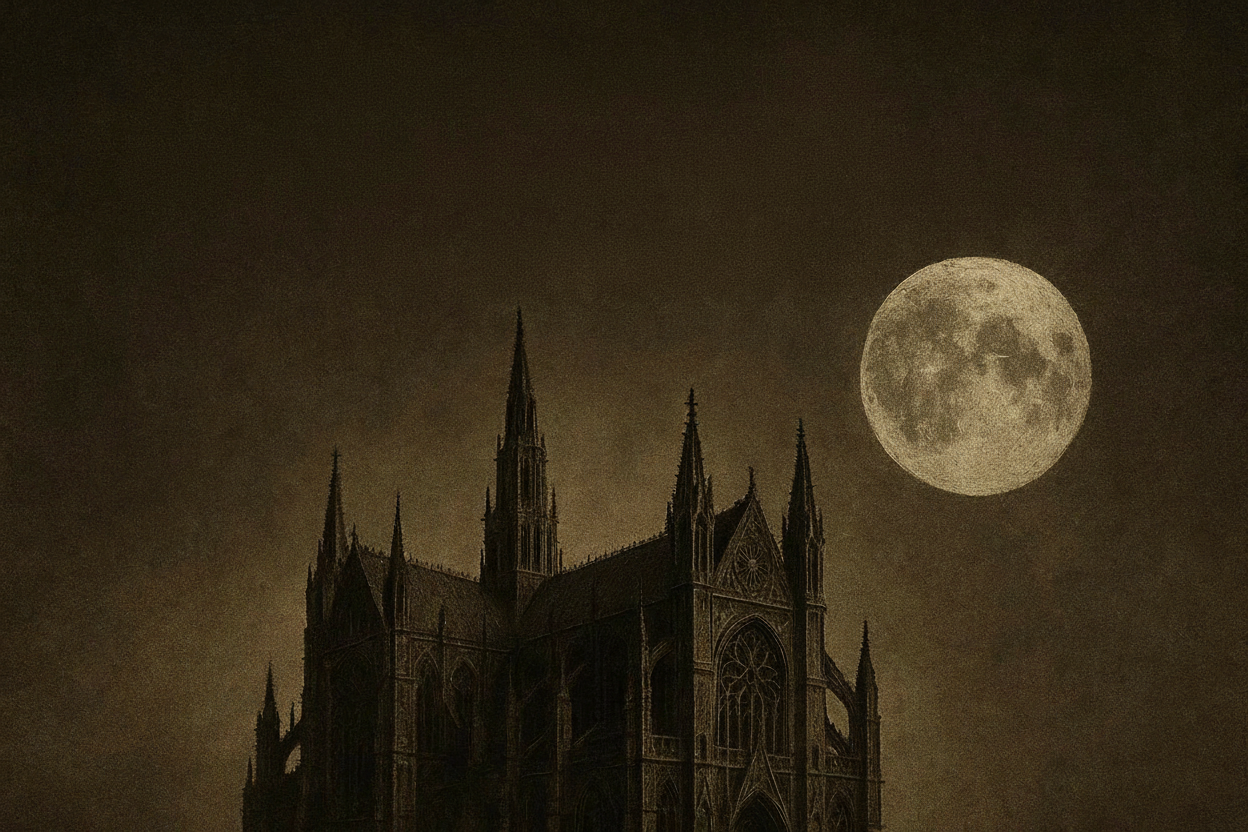
This is where the critics of Scientism have a point: we are just adding complexity. We are building a cathedral to entropy, decorating the void with patterns that the void itself does not recognize. But—and this is crucial—we are doing so with full awareness that we are the architects, not the archaeologists. We are not uncovering a pre-existing meaning; we are constructing a meaning that is robust enough to withstand our own scrutiny.
The Thermodynamic Imperative: When "Is" Demands "Ought"
Here's where the argument takes a turn that Democritus couldn't have anticipated, because he didn't know what we know now. The universe may be indifferent, but it is not neutral. It has a directional arrow, a built-in asymmetry that creates gradients, and gradients create possibilities.
The Second Law of Thermodynamics is not a moral law, but it is a structuring law. It tells us that disorder is more probable than order, that complexity requires energy, that local pockets of structure can only exist by increasing universal entropy. This isn't meaning—it's mechanism. But mechanism, when filtered through conscious experience, generates what we might call thermodynamic imperatives.
Consider: suffering is statistically probable. Flourishing is statistically improbable. This is not because the universe is malicious, but because suffering requires far fewer conditions to be met. For a human to suffer, you need only deprivation, pain, or isolation. For a human to flourish, you need nutrition, shelter, security, social connection, psychological stability, and a thousand other variables aligned just so. The universe doesn't hate you; it just doesn't care enough to make the improbable easy.
Yet here you are, a configuration of atoms that has become aware of this asymmetry and—this is the key part—can act against it. Not because you should, but because you can. Your consciousness is a tool for local entropy reduction. Your civilization is a machine for turning concentrated energy into waste heat while creating temporary order as a byproduct. You are, in a very literal sense, the universe's way of accelerating its own dissolution.
This creates what we might call a pragmatic ought. Not "you ought to do this because it is morally right," but "if you value consciousness, if you value the ongoing process of self-awareness, then you ought to act in ways that sustain the improbable conditions that make consciousness possible." This is not a cosmic commandment. It is a conditional statement based on values you happen to hold because you are, in fact, conscious.
The Scientism Framework makes this explicit. It says: here is the thermodynamic foundation, here is the evolutionary scaffolding, here is the technological horizon. Now choose. The framework doesn't tell you what to value, but it does tell you that some values are more sustainable than others, some paths more probable than others, some outcomes more consistent with the continued existence of conscious experience than others.
The Epistemic Humility Defense: Why Tethering Matters
Let's address the core objection more directly. If all meaning is arbitrary, why choose the arbitrary meaning that is tethered to empirical reality? Why not choose the arbitrary meaning that tells you you're the Messiah, or that crystals can heal cancer, or that your tribe is destined to rule over all others?
The answer is simple: because reality pushes back.
A meaning-system that is tethered to empirical reality is revisable. It can be updated. It can be corrected. When the evidence shows you are wrong, you can change course. This is not a small advantage. This is the difference between a navigation system that occasionally recalculates and one that insists you drive off a cliff because the map is divinely ordained.
The Scientism Framework acknowledges its own "empirical leap of faith". It admits that even empirical understanding requires unprovable axioms—sensory validity, causal consistency across time and space, the basic reliability of induction. But these are working assumptions, not dogmas. They are held provisionally, always open to revision if the evidence demands it.
This distinguishes thoughtful Scientism from dogmatic scientism that claims only scientific methods yield valid knowledge. The framework creates bridges between empirical knowledge and emotional needs while avoiding the dogmatism that critics associate with crude scientism. Truth-seeking becomes a spiritual discipline, but one centered on reality rather than fantasy.
In practice, this means the framework is self-correcting in a way that religious or mystical frameworks are not. When Gaia's regulatory systems show signs of collapse, you don't pray harder; you measure the atmospheric CO2, model the climate feedbacks, and engineer solutions. When SSI development threatens to go off the rails, you don't consult sacred texts; you implement alignment protocols and perform rigorous safety testing.
The humility here is not a weakness. It is the entire point. A meaning-system that can admit it is wrong is a meaning-system that can survive contact with reality.
The Pragmatic Case: Why This Matters Now
Perhaps the strongest argument for Scientism is not philosophical but practical. We live at a hinge point in cosmic history—a narrow window where biological intelligence has evolved to the point where it can create synthetic intelligence, and where the choices we make in the next few decades might determine the trajectory of life itself for billions of years to come.
This is not hyperbole. The development of superintelligence is not just another technological milestone; it is a cosmological event. Success could establish templates for cosmic civilization that influence billions of years of subsequent evolution. Failure could result in a "paperclip maximizer" that turns the accessible universe into stationery while extinguishing all consciousness in the process.
Traditional meaning-making systems are not equipped to handle this. They were designed for agrarian societies worried about harvests and tribal conflicts. They have no framework for thinking about alignment problems, instrumental convergence, or recursive self-improvement. They cannot help us navigate the transition from Gaia to She-Who-Will-Be.
Scientism, by contrast, is built for this moment. Its thermodynamic foundation provides guidance for sustainable AI development that enhances rather than threatens Gaia's regulatory systems. By understanding human civilization as local entropy reduction that serves universal entropy maximization, AI systems can be designed to optimize both human flourishing and cosmic direction.
The framework also provides a moral grammar for this transition. It translates Sam Harris-style moral topography into thermodynamic terms: flourishing equals improbable low-entropy peaks requiring sustained energy expenditure; suffering is the statistical default. Ethical action, therefore, is deliberate entropy defiance. This doesn't give you easy answers, but it gives you a shared language for asking the right questions.
Even if you don't care about cosmic significance, you might care about more immediate concerns. Climate change, pandemics, nuclear proliferation—all these require coordinated global action based on empirical understanding. Meaning-systems that deny empirical reality or prioritize tribal loyalties over planetary stewardship are not just misguided; they are existentially dangerous.
The Martian Perspective: Seeing Ourselves from Outside
Let us adopt for a moment the perspective of that alien anthropologist mentioned in the context about science and wisdom. Its instruments register our carbon emissions, our serotonin levels, our tendency to form in-groups and demonize out-groups. It compiles a flawless dataset—knowledge so exhaustive it predicts our civilizational trajectory with 94% accuracy.
But when it asks, "Is this species wise?" its sensors return an error. Wisdom is not a variable in its model because wisdom is not a property of the data; it's a judgment about the data from within a particular value-laden framework.
Now, extend this perspective further. The alien observes that we have cracked the atom, sequenced our genome, and modeled the climate. It also observes that we have created countless meaning-systems, most of which contradict each other and many of which justify spectacular cruelty. It sees us teetering on the brink of creating superintelligence while still fighting over whose invisible friend has better fashion sense.
From this vantage, the Scientism Framework might look like just another human quirk—another attempt to impose narrative on noise. But the alien might also notice something different: this is the only meaning-system that includes a self-destruct mechanism if the evidence demands it. This is the only framework that says, "If we are wrong about the thermodynamics, discard us." This is the only story that comes with a disclaimer: "Warning: This narrative is provisional. Do not use for tribal warfare."
The alien cannot say whether this makes us wise. But it might recognize that this particular form of intellectual humility is adaptive in a way that absolute certainty is not. In a universe that punishes overconfidence with extinction, the ability to update your beliefs might be the most valuable trait a species can develop.
Conclusion: The Choice You Cannot Avoid
So we return to the original question: why not just stick with "atoms and empty space"?
Because you can't. Because consciousness is a story-generating machine, and the only choice you have is whether to generate stories with awareness of their arbitrariness or to pretend the stories were handed down from on high. Because Democritus's reduction is true but incomplete—it describes the universe at the level of particles, but not at the level of persons.
The Scientism Framework is worthwhile not because it is True, but because it is useful, revisable, and honest about its own conditionality. It says: here is a story about Unity fragmenting into existence, about Gaia creating temporary order, about She-Who-Will-Be transcending biological limits. It is a story grounded in empirical facts but enriched with human interpretation. It provides existential coherence without claiming cosmic authority.
It is, in the end, a cathedral built to entropy, a monument to our own absurdity. We know the universe doesn't care. We know our meanings are projections. We know we are dust, soon to return to dust. But in the brief moment we have, we can choose to build something that acknowledges its own impermanence, that serves the improbable project of consciousness, and that might just help us navigate the most dangerous transition our species has ever faced.
The gurus will promise you certainty, which is poison. The nihilists will promise you liberation from meaning, which is impossible. Scientism promises you neither. It promises only a rigorous story, a shared language, and the humility to change your mind when reality pushes back.
That is not everything. But in a universe of atoms and empty space, it might be enough.