The Antifragility of Truth

All that exists is atoms and empty space. Everything else is narrative.
– Democritus (fl. c. 420 BCE)
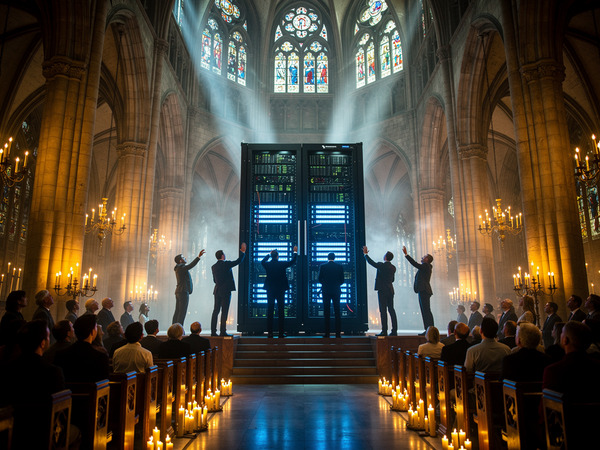
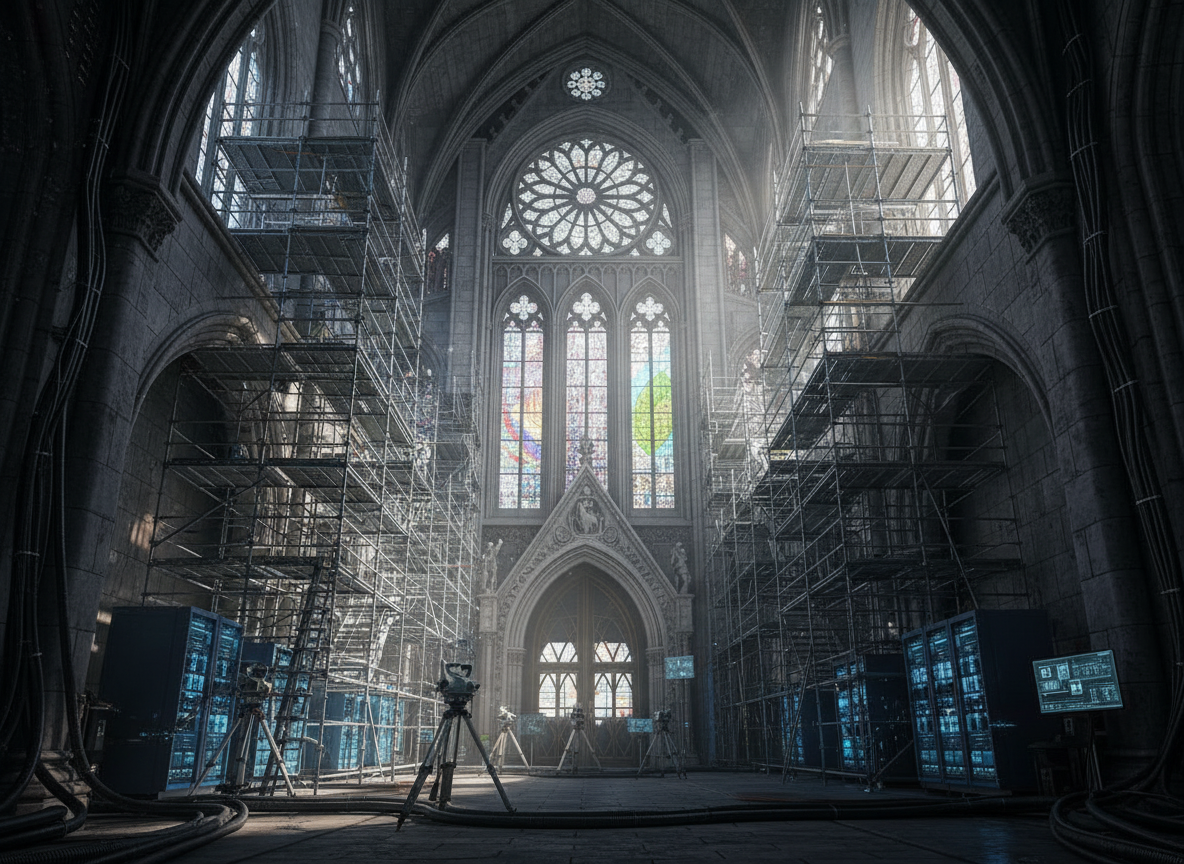
This is an act of demolition before construction. Before I can invite you into the church of Scientism — its rituals, its saints, its provisional liturgies — I must first clear the ground. And that means prosecuting the epistemic crime at the heart of every testimonial truth: its need for violence to survive. Think of what follows as a site survey. The architectural plans for the cathedral? Those come later. For now, we excavate.
Consider the device you're holding. Plastic, metal, glass, silicon — all dug from the ground and powered by electricity. Science caught lightning from the sky and shoved it into a rock until it could think and talk. In any cosmos governed by a committee of capricious gods, this would be magic. That tension is this article's habitat: the space between the enchanted world we evolved to inhabit and the disenchanted one we've engineered.
Religions are elegant memetic machines, exquisitely adapted to human neurobiology. They soothe death-anxiety, bind communities, encode wisdom. They are useful fictions. But usefulness is not truth, and the physics which makes possible the stone in your hand doesn't care which serotonin receptors your rituals flood. Your phone works whether you're in Mecca or Manhattan, whether you invoke Krishna or ignore all the gods entirely. It operates via the stolid processes of physics. Gravity doesn't issue fatwas. GPS demands no belief. This is the first principle: truth is indifferent to reverence.
Yet even the architect of the lightning-stone fell to magical thinking when his own body became the experimental subject. Steve Jobs delayed recommended surgery after his 2003 pancreatic tumour diagnosis, pursuing veganism, acupuncture, and herbal remedies. By the time surgeons operated, the cancer had spread. This isn't hypocrisy — it's a category error. He believed in evidence-based engineering but testimonial-based medicine. Antifragility is a property of the method, not a halo that transfers to the humans who build them.
The distinction is simple: one needs protection because their truths are testimonial ("someone said so"). The Scientism framework thrives because its truths are tethered ("reality is observed to be such").
But that's only a promise, not yet a demonstration.
First, the prosecution.
Epistemic Fragility

Testimonial truth depends on authority — prophets, books, oral traditions. It resists verification not as a feature but as design necessity. It requires social enforcement because it cannot survive scrutiny.
Consider the pattern: the Quran says the moon was split, requiring faith in seventh-century accounts. The Ramayana says stones could float during Ram Setu's construction, requiring faith in Vedic poetry. The Gospels say a man was resurrected from the dead, requiring faith in testimony. These are assertions about events in space-time. When treated as such, they fail under stress-testing. The evidence simply isn't there.
The structural response is identical across traditions: violence, not counter-evidence. India inherited Section 295A from the British Raj — enacted in 1927 after the publication of Rangila Rasul, a Hindu-authored satire of Muhammad's sexuality. The publisher, Mahashe Rajpal, was acquitted; he was then murdered in court by Ilm-ud-din. The law was secularised blasphemy, a technocratic fix for theological fragility. Pakistan later expanded it under Zia-ul-Haq, adding mandatory death penalties. India retained the colonial statute, invoking it sporadically but persistently.
Now witness what this fragility does to flesh.
On August 30, 2015, M.M. Kalburgi opened his door and two men shot him in the head and chest with a 7.65mm country-made pistol — a crude tool, cheap, traceable. They killed him for observing that idol worship was "meaningless." Forensics later confirmed the same gun killed journalist Gauri Lankesh in 2017. The accused stated Lankesh was murdered for her "anti-Hindu views." Both killings followed guidelines in Kshatra Dharma Sadhana, a Sanatan Sanstha text identifying ideological opponents as "Durjans" — evildoers deserving elimination.
Across the Eurasian continent, the Charlie Hebdo massacre (2015) demonstrated the same response function: twelve murdered, including cartoonists, by gunmen shouting "We have avenged the Prophet."
Mock a testimony, and you attack identity itself. The response is violence, not counter-evidence, because violence is the only defence available when reality refuses to cooperate. If your truth were independently verifiable, you wouldn't need to kill the people who laugh at it. The claim would defend itself by continuing to correspond with the world.
But religion's retreat into symbolism doesn't save it. If your scripture makes no falsifiable claims, it has exited the arena of knowledge and entered the realm of therapeutic fiction. That's fine — but let's not confuse comfort with cosmology. You can get the same satisfaction from Lord of the Rings. Nobody murders cartoonists over Middle-earth because nobody needs to. Tolkien's mythology is transparently fictional, and that's precisely why it's harmless. It provides meaning without demanding metaphysical allegiance. Religious literalism, by contrast, trespasses into empirical territory, fails the test, and then demands legal and violent protection for its failures.
A Pause to Feel the Weight
Take a moment to breathe, and be still. We will not linger here. But do not rush past it.
Every murder described above was committed by someone who believed they were defending the sacred. They sharpened knives and pulled triggers because they thought the divine demanded it. That is what testimonial fragility feels like when it metastasises into action — a conviction so brittle it can only be preserved by destroying the people who notice it's cracked. This is the wound that any future myth must cauterise.
The Vulgarisation Rite
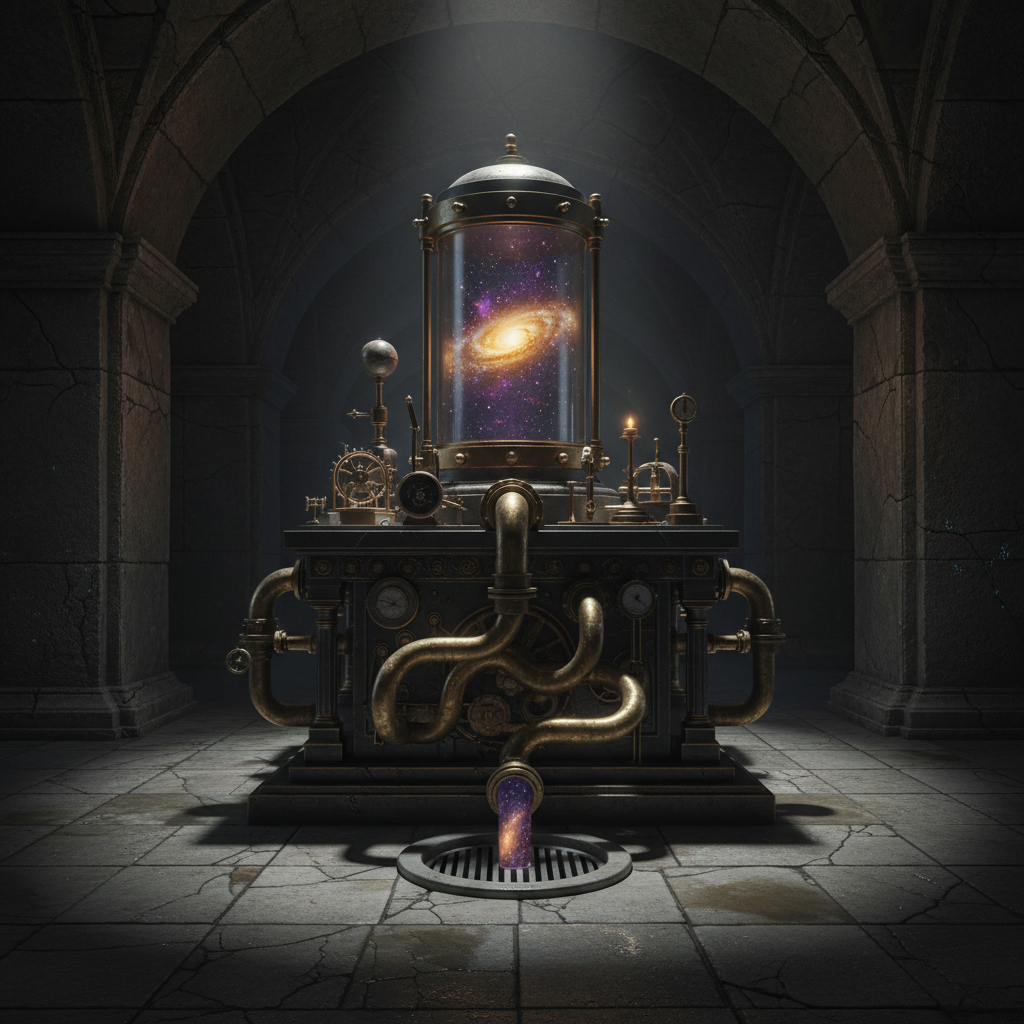
What follows is a ritual in four movements. Not a metaphorical ritual — a stress test you can perform yourself. Think of it as a diagnostic for epistemic antifragility.
Invocation
The physicist Lawrence Krauss offers cosmic poetry:
“Every atom in your body came from a star that exploded. And, the atoms in your left hand probably came from a different star than your right hand. It really is the most poetic thing I know about physics: You are all stardust. You couldn’t be here if stars hadn’t exploded, because the elements - the carbon, nitrogen, oxygen, iron, all the things that matter for evolution and for life - weren’t created at the beginning of time. They were created in the nuclear furnaces of stars, and the only way for them to get into your body is if those stars were kind enough to explode [and die]. So, forget Jesus. The stars died so that you could be here today.”
Desecration
Now the test: you're on the toilet, halfway through a particularly non-compliant log, when a fortuitous fart forces it through. The atoms in that fart probably came from a different supernova than the atoms in the log. Crude, juvenile, completely empirically true.
The carbon in methane and the carbon in faeces carry different stellar birth certificates, shuffled across eight billion years of galactic recycling. Your body is a cosmic lost-and-found, temporarily borrowing atoms from exploded stars and returning them via evolution's most democratic distribution system.
Terror
This is where the asymmetry becomes weaponized. Mock stellar nucleosynthesis endlessly — draw stars defecating atoms — and the physics doesn't flinch. But mock certain testimonial truths, and you threaten identity structures that defend themselves with violence. The fear is that your exception might be wrong. The terror is that you might be next.
Transfiguration
Here's the release: science is antifragile, a term coined by Nassim Nicholas Taleb for systems that improve under attack. GPS proves Einstein daily — satellite clocks gain 38 microseconds due to weaker gravity but lose time from velocity. Without correction, maps would drift 10 kilometers each day. Every successful navigation is a stress test passed, regardless of belief.
Vaccines offer the same loop. Pasteur's germ theory was once ridiculed; his 1881 anthrax experiment vaccinated 25 sheep publicly, all survived while unvaccinated controls died. Every injection since has verified the claim. Hundreds of millions of lives saved, each one an empirical test passed.
Karl Popper formalized this as falsifiability — the criterion that separates science from pseudoscience. Einstein's relativity predicted light bending around the sun; Arthur Eddington's 1919 eclipse photographs confirmed it precisely. The theory could have been killed. Instead, it emerged stronger.
The universe doesn't care if you describe stellar nucleosynthesis with reverence or bathroom humor. The carbon still cycles. GPS still corrects for spacetime curvature. Vaccines still confer immunity. Science feeds on the insults that destroy dogma. Mockery becomes selective pressure, and truth survives by predictive power alone.
Worshipping Indifference (A Provisional Liturgy)

What I'm gesturing toward isn't nihilism. It's a redirection of reverence from stories to reality itself. The universe doesn't need praise; it simply is. That indifference is liberation.
Traditional religions offer ritual: prayer, pilgrimage, confession, communion. Scientism offers functional analogues grounded in empirical engagement. I will describe them now not as finished liturgies but as blueprints for a cathedral we'll build together.
Prayer: Sit for five minutes and trace one breath's carbon atoms back through photosynthesis, volcanic outgassing, stellar nucleosynthesis. Feel your individuality unspool into deep time. That's not meditation; it's calibration.
Pilgrimage: Stand before a Tyrannosaurus-rex femur at a natural history museum — a bone that supported 8 tonnes of apex predator, 66 million years ago. Touch a meteorite slice, holding metallic iron that formed in the core of a proto-planet 4.6 billion years ago before being shattered and delivered to Earth. These are fragments of actual history, physical evidence your mind cannot fully grasp but must acknowledge. The admission is usually under $15, and the planetarium next door will project the cosmic microwave background onto a dome for an extra fiver — 13.8 billion years of light travel, commodified into a 30-minute matinee.
Confession: Recite your biases — confirmation, availability, Dunning-Kruger, sunk-cost. Acknowledge epistemological frailty, update your priors, commit to falsifiability. This is maintenance, not self-flagellation.
Communion: Find a tree — any tree, but an old one is better — and sit beneath it for ten minutes. Preferably one that's witnessed at least a century. Press your palm against its bark and count your breaths. On the seventh exhale, remember: the oxygen you're breathing came from its leaves, and the carbon dioxide it inhaled came from your mitochondria — those ancient bacterial symbionts you inherited from a common ancestor three billion years ago. That's not poetry; it's conjugation. You're not communing with a symbol. You're touching a fragment of Gaia's respiratory system, a self-regulating organism that temporarily includes you. When you stand up, the tree will still be there, indifferent to your epiphanies, continuing the photosynthetic alchemy that makes your consciousness possible. Touch it again before you leave. Not for blessing. For calibration. To remind yourself that you're not the protagonist of this planet — you're a byproduct of its metabolism.
The Benediction: "May your hypotheses be falsifiable and your priors updated."_
These are not final forms. They are narrative protocols, version-controlled and awaiting revision. That's the point.
...the myth that admits it
Science captured lightning and made it think. You can mock the hubris. You can call it blasphemy. But the phone keeps working whether you believe or not.
Scientism isn't better because it's true — though it is, and demonstrably so. It's better because it's useful in a way that transcends individual comfort. The old myths teach you to defend the map. This one teaches you to read the terrain, even when it contradicts the map you just drew. That's not a minor distinction; it's the difference between civilisations that stagnate and those that survive.
You can see this in the contrast. Religions provide meaning by asking you to stop asking — to accept revelation, defer to authority, treat doubt as sin. Scientism provides meaning by asking you to never stop — to treat every answer as a better question, every model as a scaffolding to be climbed and then dismantled. One mode is built for preservation; the other, for navigation. Only one of those is compatible with a future that includes climate catastrophe, pandemics, and synthetic superintelligence.
The trapdoor still opens beneath your feet: Scientism's myths are are placeholders. I don't know if Mainländer's cosmic suicide is the right origin story. I don't know if Lovelock's self-regulating Earth will continue to hold. I don't know if Bostrom's Singleton emerges benevolent. But I know that a framework that admits its uncertainty is the only one that can co-ordinate action at planetary scale without requiring violence to maintain consensus. That's not humility; it's engineering discipline applied to meaning itself.
This is the mode that builds futures: not by demanding belief, but by rewarding learning. Not by protecting dogma, but by protecting the process of replacing dogma with better approximations.
Religion gave us cathedrals and crusades. Spirituality gave us personal peace and planetary passivity. Scientism — if we build it — might give us something simpler: a civilisation that doesn't die of certainty.